

What is the energy efficiency of an air cylinder?
Leave a message

As a supplier of air cylinders, I often encounter questions from customers about the energy efficiency of these mechanical marvels. Energy efficiency has become a crucial factor in industrial applications, and understanding how air cylinders perform in this regard is essential for making informed decisions.
1. Basics of Air Cylinders
Air cylinders, also known as pneumatic cylinders, are devices that convert compressed air energy into mechanical motion. They are widely used in various industries, such as manufacturing, automotive, and food processing. The basic principle behind an air cylinder involves the introduction of compressed air into a chamber, which then pushes a piston, causing linear motion.
Most air cylinders consist of a cylinder barrel, a piston, a piston rod, and end caps. The compressed air enters through one end of the cylinder, exerting force on the piston. This force overcomes the resistance and moves the piston along the cylinder, resulting in the extension or retraction of the piston rod.
2. Factors Affecting Energy Efficiency
Compressor Efficiency
The efficiency of the air compressor that supplies the compressed air plays a significant role in the overall energy consumption of an air - cylinder system. A poorly efficient compressor will consume more energy to generate the required pressure, even if the air cylinder itself is efficient. For example, older compressors with worn - out components may have a lower efficiency rating, leading to higher energy usage. Regular maintenance and upgrading to more modern, energy - efficient compressors can significantly improve the overall system efficiency.
Friction
Friction within the air cylinder can have a substantial impact on energy efficiency. Friction occurs between the piston and the cylinder wall, as well as in the seals. Higher friction means more energy is required to move the piston. Manufacturers use advanced materials and coating technologies for the piston and seals to reduce friction. For instance, using low - friction polymers as seal materials can minimize the energy lost due to mechanical resistance.
Leakage
Air leakage is one of the major culprits in energy wastage in pneumatic systems. Even small leaks can accumulate over time and result in significant energy losses. Leaks can occur at connections, seals, or due to damaged components. Regular inspection and maintenance to detect and repair leaks are essential. For example, performing air leak tests using ultrasonic leak detectors can help identify and fix leaks promptly.
Load and Pressure Requirements
The energy efficiency of an air cylinder is also influenced by the load it needs to move and the pressure required to move that load. If an air cylinder is oversized for the task, it will consume more energy than necessary. On the other hand, if it is undersized, it may not be able to perform the required work efficiently, leading to increased energy consumption as the compressor tries to meet the demand. Selecting the right - sized air cylinder for the specific application is crucial for optimizing energy efficiency.
3. Measuring Energy Efficiency
Work Output and Energy Input
The energy efficiency of an air cylinder can be measured by comparing the work output to the energy input. The work output is the mechanical work done by the air cylinder, which is calculated as the force applied by the piston multiplied by the distance the piston moves. The energy input is the energy consumed by the compressor to supply the compressed air.
Mathematically, efficiency (η) can be expressed as: η = (Work Output / Energy Input) × 100%. However, accurately measuring the energy input can be challenging as it involves accounting for the compressor's efficiency, losses in the air distribution system, and other factors.

Specific Energy Consumption
Another way to assess energy efficiency is to calculate the specific energy consumption (SEC) of the air - cylinder system. The SEC is defined as the energy consumed per unit of work done. A lower SEC indicates higher energy efficiency. For example, if System A consumes 10 kWh to perform 1000 Nm of work, while System B consumes 8 kWh for the same amount of work, System B has a lower SEC and is more energy - efficient.
4. Improving Energy Efficiency
Proper Sizing
As mentioned earlier, selecting the right - sized air cylinder for the application is crucial. Conducting a detailed analysis of the load requirements, including the maximum force needed and the stroke length, can help in choosing an appropriate air cylinder. This ensures that the air cylinder operates within its optimal range, reducing energy consumption.
Use of Energy - Saving Valves
Energy - saving valves, such as pressure regulators and flow control valves, can be installed in the pneumatic system to optimize the energy consumption. Pressure regulators can maintain a stable and appropriate pressure, preventing over - pressurization, which can lead to increased energy usage. Flow control valves can regulate the flow of compressed air, ensuring that the air cylinder moves at the required speed with the minimum amount of air.
Recycling Exhaust Air
Some advanced systems can recycle the exhaust air from the air cylinder. The exhaust air still contains a certain amount of pressure energy, which can be used for other low - pressure applications. For example, in a multi - cylinder system, the exhaust air from one cylinder can be used to power another cylinder in a less energy - intensive task.
5. Application of Air Cylinders and Energy Efficiency Considerations
Manufacturing
In manufacturing plants, air cylinders are used in various operations such as material handling, assembly, and packaging. For example, in an assembly line, air cylinders are used to move parts from one station to another. Here, energy efficiency is crucial as the continuous operation of multiple air cylinders can consume a large amount of energy. By optimizing the design of the pneumatic system, including proper sizing of cylinders and the use of energy - saving valves, significant energy savings can be achieved.
Pneumatic Drive Of Spot Welding Machine
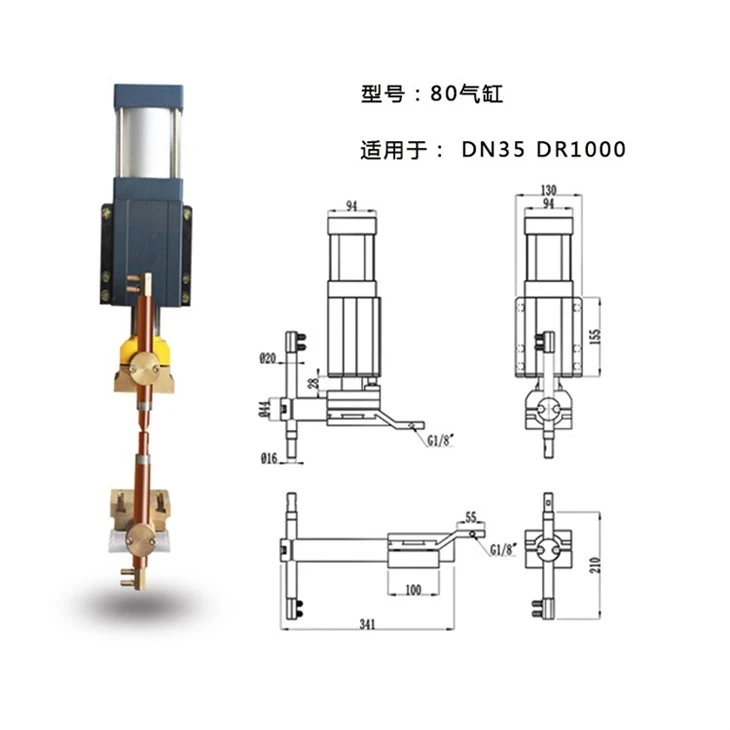
In the case of a spot - welding machine with a pneumatic drive, energy efficiency is of utmost importance. The air cylinder in the spot - welding machine needs to provide a precise and consistent force for welding. To ensure energy efficiency, a well - designed air - cylinder system with low friction components and proper pressure control is required. Additionally, minimizing air leakage is essential to reduce energy waste.
Conclusion
The energy efficiency of an air cylinder is a complex but crucial aspect to consider in industrial applications. Multiple factors, such as compressor efficiency, friction, leakage, and load requirements, can affect the energy consumption of an air - cylinder system. By accurately measuring energy efficiency, making improvements in sizing, valve usage, and exhaust air recycling, and considering application - specific requirements, significant energy savings can be achieved.
If you are interested in learning more about air cylinders and how to optimize their energy efficiency for your specific application, we invite you to contact us for a detailed discussion. Our team of experts is ready to assist you in finding the best solutions for your business needs.
References
- Alexander, P. (2018). Pneumatic Systems: Design, Installation, and Maintenance. Industrial Press.
- Brown, R. (2020). Energy - Efficient Pneumatic Technologies. Energy Journal.


